
Why the schema matters
When building Power BI reports, it’s important not only to load the data, but also to model it correctly. Report speed, how filters work and the clarity of DAX formulas all depend on the table structure.
If you’re not yet sure how tables and relationships work, it’s worth first reading:the Power BI data model and relationships.
What a Star schema is
A Star schema– is a structure where a single fact table is at the center, with dimension tables directly connected around it.
For example, at the center you might haveSales, and around it –Products, Customers, RegionsandCalendar.
- a simple structure
- clear 1:* relationships
- faster reports
- easier to write DAX formulas
What a Snowflake schema is
A Snowflake schema– is a split-up structure where dimension tables are additionally connected to other dimensions.
For example:Products → Categories → SuppliersorCustomers → Cities → Regions.
- less data duplication
- more tables and relationships
- a more complex filter path
- DAX can become harder to understand
A more complex schema directly affects the filter context. More on this:how DAX sees data: row vs filter context.
Star vs Snowflake comparison
The main difference is simple:A Star schemaaims for simplicity, while aSnowflake schema– aims for greater normalization.
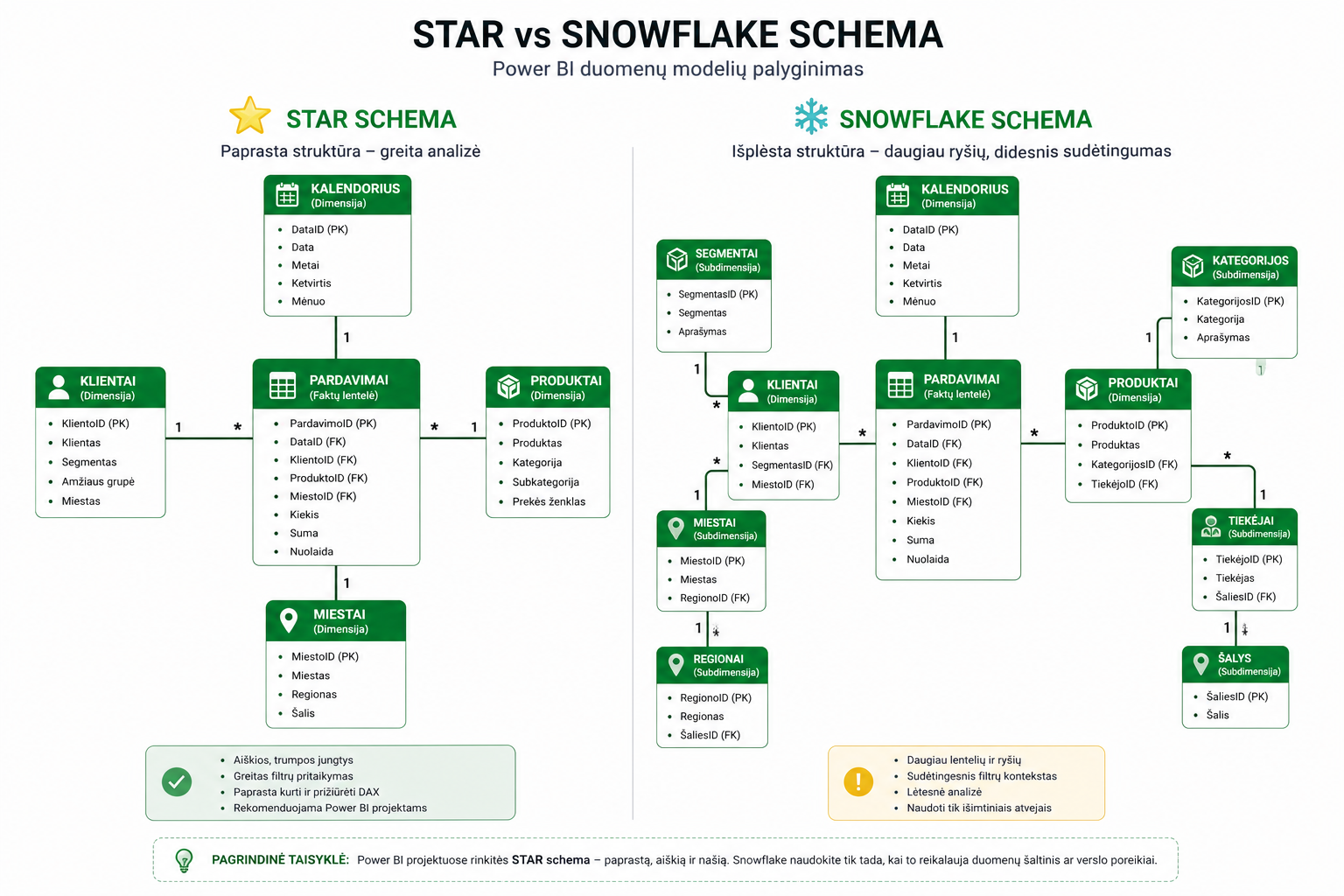
- A Star schema– is faster, clearer and more convenient for analysis.
- A Snowflake schema– is more detailed, but more complex and often slower.
When to choose Snowflake
Although in most cases a Star schema is better in a Power BI model, Snowflake can sometimes be useful.
- when the data already comes normalized from a database
- when you need to reduce data duplication
- when the model resembles a data warehouse more than an analytical report
- when the company’s data governance rules require it
Still, in analytical Power BI models, a simpler structure usually means fewer errors and clearer calculations.
If, after building the model, you move on to calculations, start with:an introduction to DAX.
What to read next
A short conclusion
In the Power BI environment, simplicity usually wins.A Star schemalets you build faster, clearer and more maintainable models.
A Snowflake schemais useful only in specific cases, when detail or data normalization is more important than simplicity.
Power Query cheat sheet: automate your report
The key steps, the 5 common mistakes, and when automating is worth it.
- PDF · 2 pages, practical
- No spam — value only